Contents
- Signs your box league is ready for an upgrade
- Put the table where everyone can see it, the day a match is played
- Make arranging a match one message
- Let players enter and confirm their own scores
- Nudge the unplayed matches on a fixed schedule
- Celebrate the results as they come in
- Build next season from the final table
- Give every player a level, calculated from their results
- Keep a record for every player
- Share the running of it
- Use the league to bring in new members
- What each upgrade gives you
- How Clayside does this
- Questions organisers ask
Most clubs that run a box league got it going the same way: a spreadsheet, a group chat and one keen organiser. If you have not got that far yet, start with how to run a tennis box league, which covers box sizes, formats, scoring and the rules to agree.
This post is for the next stage. The league runs, but it could be better. The same players carry it every round, the table is always a week behind, and the organiser cannot take a fortnight off without it stalling. Nine upgrades fix most of that. Each one makes the league better to play in, brings new members to the club, or saves the organiser time, and some do all three.
Signs your box league is ready for an upgrade
- Most matches are played in the last week of the round.
- The table is updated when the organiser has a free evening, not when a match is played.
- The same two or three people in each box never arrange anything.
- New members are placed in a box by guesswork.
- Nobody outside the league knows it exists.
- The league stops whenever the organiser goes on holiday.
If two or more of those sound like your club, read on.
Put the table where everyone can see it, the day a match is played
A table that is a week behind takes the life out of a round. Nobody knows whether a win this week will take them to the top, so nobody hurries to play. A table that changes the evening a match is played gives every player a reason to get their next one booked.
Three things make a table live:
- Scores go in the day they are played, by the players, not saved up for the organiser.
- Everyone can see every box, not only their own. People like to see how their friends are getting on.
- The table is on the club website, not only in the group chat. A visitor who sees forty members playing every week sees a club worth joining.
| Player | DB | DM | FM | MJ | GP |
|---|---|---|---|---|---|
| D. Byrne | 6-4 6-2 | 7-6(5) 6-3 | 7-6(5) 4-6 8-10 | 6-2 6-4 | |
| D. Martin | 4-6 2-6 | 3-6 4-6 | 1-6 3-6 | 6-4 3-6 7-10 | |
| F. Mortimer | 6-7(5) 3-6 | 6-3 6-4 | 6-1 6-4 | 6-3 7-5 | |
| M. Jackson | 6-7(5) 6-4 10-8 | 6-1 6-3 | 1-6 4-6 | 4-6 5-7 | |
| G. Poynter | 2-6 4-6 | 4-6 6-3 10-7 | 3-6 5-7 | 6-4 7-5 |
Make arranging a match one message
Most unplayed matches are not refusals. They are a text that started a conversation about dates, which nobody finished. The fix is to make the first message do the work: offer three times, and let the other player take one with a single answer.
Two habits help:
- Offer times, not “when are you free?” Three evenings, a few days apart. Your no-show rule can then rest on whether dates were offered, which is fair to the player who did the asking.
- Ask the whole box at once. A player who owes four matches can offer the same evening to everyone they still have to play, and the first to say yes gets it.
The best version of this needs nobody to swap phone numbers. A member who would never hand their number to a stranger will happily play one.
Let players enter and confirm their own scores
If every score goes through the organiser, the organiser is the bottleneck. Let either player enter the score, and the other confirm it. If nobody objects within a few days, it stands. If somebody does, the box’s organiser is told and sorts it out.
That way the organiser sees only the scores that are wrong, not the forty that are right. A mistyped set is usually fixed in one message between the two players.
Nudge the unplayed matches on a fixed schedule
A reminder only from the organiser feels personal, and gets sent late or not at all. A reminder on a fixed schedule is just how the league works. Many clubs nudge anybody with a match still to play two weeks, one week, three days and one day before the round closes.
Then close the round on the day you said. An unplayed match scores nothing for either player, and the next round starts. Extending the deadline once teaches everyone it is not real. The halfway reminder in the box league guide is a good message to copy.
Celebrate the results as they come in
The best box leagues are a community first. The rules keep it fair, but what brings people back is being noticed:
- The upset. A player from a box below beating a player from the box above.
- The comeback. A win after losing the first set.
- The box winner, and the clean sweep when somebody wins every match.
- The first win. For a new member, it is the match that decides whether they stay.
Post a short round-up every week: the matches played, the best story, and a line for anybody who has not played yet. Let people say “well played” to each other. A league where results are celebrated gets more matches played than one where they are only counted.
Some members would rather not have their results shown off. Let them keep their matches out of the round-up, while still playing in the box.
A league where results are celebrated gets more matches played than one where they are only counted.
Build next season from the final table
Promotion and relegation is the engine of a box league, and the part most organisers dread at the end of a round. Make it a rule, not a judgement:
- Move the same number up and down from every box. One each way with boxes of five or six, two with seven or eight. The box league guide has the details.
- Set a minimum to go up. A player who played only one match does not go up, and the next player down goes instead.
- Relegate anybody who played nothing. It is fair to the people who did, and it keeps the top boxes for people who turn out.
- Ask who wants to play next round before you build it. Anybody who does not answer can sit it out, rather than becoming two unplayed matches in somebody else’s box.
- Allow a jump of two boxes for a player who won every match comfortably and is clearly in the wrong place. Use it rarely, and only when both the result and the player’s level say so.
Then start the next round the day the last one closes. The gap between rounds is where box leagues lose their players.
Give every player a level, calculated from their results
The hardest question in a box league is where to put somebody: a new member, a player back from injury, a junior moving up. A club level answers it.
A level is a calculation, not anybody’s opinion. Every result moves both players’ numbers. Beat somebody rated above you and yours goes up a lot; beat somebody below you and it barely moves. A one-sided score moves it further than a close one. Every match at the club feeds the same number, whether it was played in a box, on the ladder or at a club night.
Use it to:
- Place newcomers in the right box after a few results.
- Keep boxes even, and spot one that is much stronger than the box above.
- Seed the club championships. See how to make a tournament draw with byes for where the seeds go.
- Find a fair game between rounds.
Give it no prize. Once a number has a trophy attached, people protect it by ducking strong opponents. If your club would rather members did not see each other’s levels, keep them for the organisers.
Keep a record for every player
Players love their own numbers. A record gives every member the story of their own season, and gives two players something to talk about before they meet.
A good player record holds:
- Played and won, this round and all time, and the last five results.
- Head to head against every opponent: who has won more, and every match between them.
- Who they play most, which is where the club’s rivalries are.
- The numbers players argue about: deciding sets won, tiebreaks won, wins from a set down and the best winning run.
- Where they finished in every box, and whether they went up or down.
Records help you too. Most matches played, most improved and best comeback make good end-of-season prizes alongside the box winners, because a newcomer can win them. On a spreadsheet, a record like this is a job nobody has time for. Kept with the results, it builds itself. Tracking player stats and records at your club covers what to track and the rules that keep it fair.
Share the running of it
One organiser can look after four or five boxes. Past that, give each box a box manager: a player in the box who nudges the slow matches, settles small disputes and keeps the friendly side going. The organiser then deals with a handful of box managers instead of forty players, and can go on holiday.
Write down what the job involves before you ask anybody to do it. Club committee roles: what each job involves has a one-page description to copy.
Use the league to bring in new members
A box league is one of the best things a club can offer a new member. It promises a match every week against somebody of their standard, which is what most people joining a club want. Make the most of it:
- Say so on the club website and the joining page, with the live tables there for anybody to see.
- Let new members join at the start of any round, not only at the start of the season.
- Place them where they can win a match. A first round of four straight defeats is how a new member is lost.
- Offer something between rounds. A social night or a club night gives them people to play with while they wait. See who plays next: rotation systems for club nights and tennis round robin formats.
Some members will never take to a box league, and would rather pick their own opponents. A ladder alongside the boxes suits them. Ladder or box league: which suits your club compares the two, and how to get more members for your club covers the rest of the welcome.
What each upgrade gives you
| Upgrade | Better for players | Brings in members | Saves the organiser |
|---|---|---|---|
| A live table | Every win shows the same day | The tables on the club website | No Sunday evening updating it |
| Arranging in one message | No numbers swapped, fewer missed matches | Newcomers can arrange with strangers | No chasing who is free |
| Players enter and confirm scores | Results count straight away | Only the disputes reach you | |
| Nudges on a fixed schedule | A reminder before it is too late | No personal chasing | |
| Celebrating results | Being noticed for an upset or a first win | A league that looks alive | |
| Next season from the table | Clear, fair rules about moving | An evening’s work becomes a check | |
| A level from every match | Fair boxes and fair games | Newcomers placed properly | No guesswork |
| Player records | Their own numbers, and every head to head | Something to talk about at the club | Prizes a newcomer can win |
| Box managers | Somebody who knows everyone in the box | The job is shared |
How Clayside does this
Everything above can be done by hand, and many clubs do. Clayside is software built to do it for you, and every upgrade in this post is something it does:
- Live tables. Every box’s table updates the moment a score is confirmed. It is on your club website within a minute too, through a widget you paste in once.
- Arranging a match. A player picks up to a few times they could play and sends them. The opponent taps one and it is agreed, or the player asks the whole box at once. Nobody’s phone number moves.
- Scores the players enter and confirm. The opponent confirms, or it stands after a few days. The organiser is told only when a score is rejected.
- Nudges on a schedule. Anybody with a match still to play is reminded 14, 7, 3 and 1 days before the round closes, in the app and on their phone. After an agreed match with no score, both players are asked for it the next morning.
- Clubhouse. The club’s last fortnight on one screen: upsets, comebacks, box winners, finals, first wins and winning runs, with “well played” for each, and a round-up every Monday.
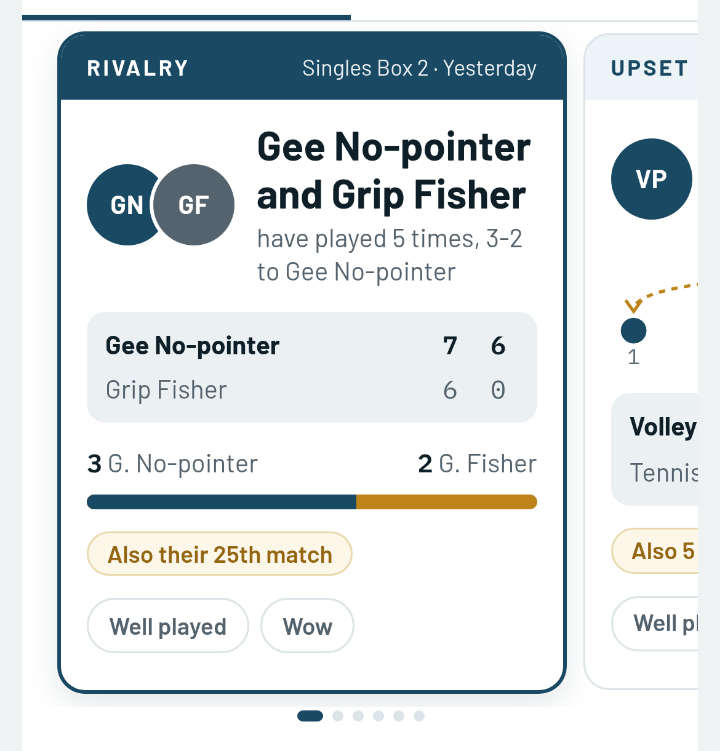
- Promotion and relegation, built for you. Next season is built from the final table as a plan for you to check. It makes the moves you set, holds back anybody short of the minimum and sends down anybody who played nothing. Suggested two-box jumps wait for your tap.
- A club level. One number for every member, calculated from every box, ladder, tournament and club night result, with a word for how sure it is. Your club decides whether members see it.
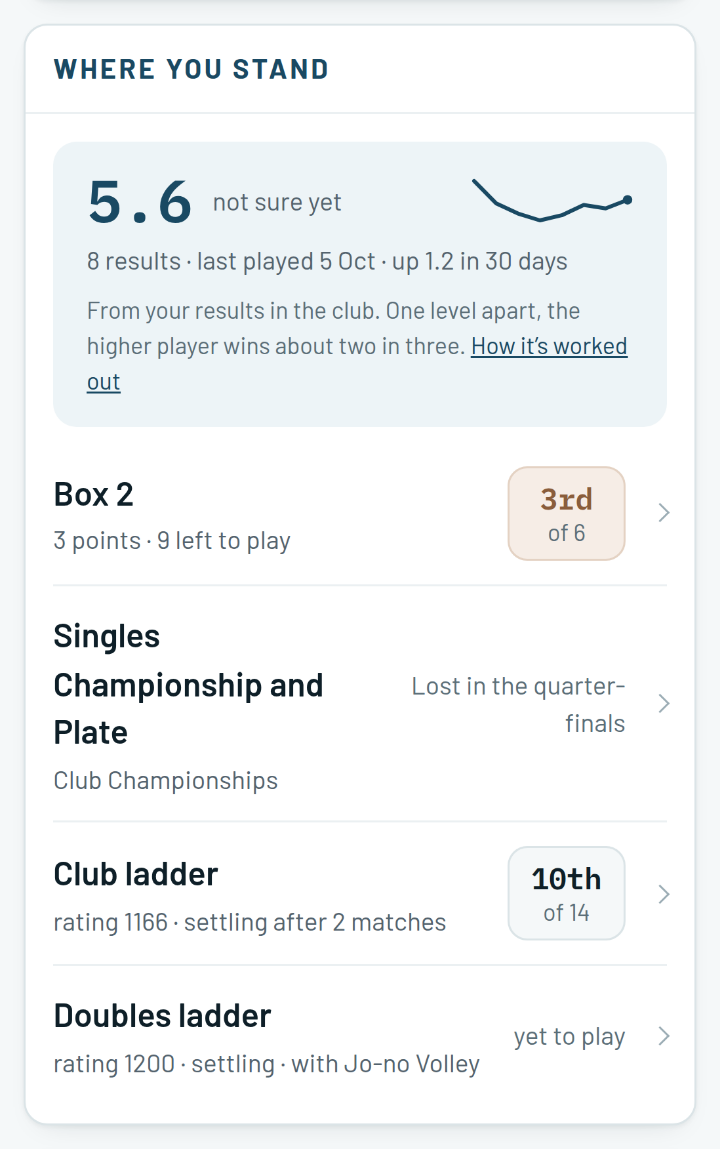
- Player records. Tap any name for their record: the last five results, your head to head, who they play most, and their deciding sets, tiebreaks and best run.
- Box admins. Give a player one box to run, and they can do that and nothing else.
- Find a game. Between rounds, a member posts when they are free and the first person around their level to say yes takes it.
The organiser starts the round and settles the odd dispute. The players do the rest, and the whole club can see it happening.
Questions organisers ask
How do you keep a tennis box league going?
Keep the table up to date, close every round on the day you said, nudge the unplayed matches before the end, and start the next round straight away. Most leagues that fade lose players in the gap between rounds.
How do you stop matches going unplayed in a box league?
Make arranging a match easy, remind players at fixed points before the round closes, and have a rule for players who never play. Relegating anybody who played no matches, and holding back anybody who played too few, is fair and usually enough.
Should a box league use player ratings?
A rating worked out from results helps place new players and keep boxes even. Keep it as a guide rather than a prize, so nobody ducks a strong opponent to protect their number.
How do you get new members into a box league?
Let them join at the start of any round, and place them by a level or a hit with a coach. Make sure their first box is one where they can win a match. Put the tables on the club website, so people see the league before they join.
How much admin does a box league take?
On a spreadsheet, an evening every week or two once the league passes forty players. With players arranging, entering and confirming their own matches, the organiser's job shrinks to starting each round and settling the odd dispute.
Filed under Competitions · Tennis