Contents
- One row per match
- What to track for every player
- Head to head is the number players check first
- Rules that keep the numbers fair
- Use the stats for recognition, not rewards
- Use the records for the AGM figures
- What members should see
- Keeping records on a spreadsheet
- How Clayside keeps every player’s record
- Questions organisers ask
Most clubs keep their results. A spreadsheet of scores, a table for each box, a list of champions on the clubhouse wall. Far fewer keep a record for each player, and that is a shame, because a record is where the stories are.
“Played 31, won 19” is a season. “Beaten Sam three times out of four” is a rivalry. “Won four matches from a set down” is a reputation. People come back to a club where their own story is told, and a record is the cheapest way to tell it.
One row per match
Every stat in this post comes from the same place: a list with one row for every match the club plays. Each row holds the date, the competition, who played, the score set by set and who won. It also says how the match ended: in full, retired, walkover, or out of time.
Keep that list, and everything else can be worked out. Lose it, or keep only the tables, and you can never answer “how have I done against her?” again.
For doubles, the row holds all four players, and which pair each was in.
What to track for every player
| Stat | What it tells the player | What it tells the club |
|---|---|---|
| Played and won | How their season is going | Who is turning out, and who has gone quiet |
| The last five results | Their form, at a glance | Who is on the rise |
| Head to head | How they get on against each opponent | Where the rivalries are |
| Who they play most | Their regular opponents | Whether people mix or stay in a circle |
| Deciding sets won | How they do when it is close | |
| Tiebreaks won | The same, at the sharp end | |
| Wins from a set down | Their comebacks | A story worth telling |
| Best winning run | Their best spell | Another story worth telling |
| How many people they have played | How widely they play | Whether newcomers are being played |
| Where they finished | Every box, ladder and draw, and whether they went up or down | Who is climbing |
Start with the first three. Add the rest when the list is long enough to make them interesting.
Head to head is the number players check first
Ask a player what they want to know before a match and it is nearly always the same thing: how have I done against this person before? A head to head answers it:
- How many each has won, counting singles only, or doubles only, but not mixed together.
- Every match between them, newest first, with the scores.
- Doubles played together, as well as against. Players like to know their record with a partner too.
Make it easy to find. The best place is one tap from the opponent’s name on the table, at the moment somebody is arranging the match.
Rules that keep the numbers fair
Decide these before anybody asks, and write them down with the competition rules:
- A walkover is listed, not counted. Nobody played, so it is neither a win nor a loss. It stays in the list so the record is complete.
- A retirement counts for whoever took it, because a match was played.
- A match that ran out of time counts for nobody. Nobody won it.
- Only confirmed scores count. A score waiting for the opponent to confirm is not in the numbers yet.
- A club night round is a share, not a match. Count more games as a win, fewer as a loss, and a level round as neither.
- Corrections replace, not add. When a wrong score is corrected, the old one leaves the record.
Squash, badminton and pickleball count games rather than sets, and points rather than games. The same stats work: deciding games won in place of deciding sets, and wins from a game down in place of a set down.
Use the stats for recognition, not rewards
The end of the season is the time to use them. Box winners and champions are worth celebrating, but they go to the same few players every year. Stats let you celebrate everybody else:
- Most matches played. It rewards the people who make the league work.
- Most different opponents. It rewards mixing.
- Best comeback of the season.
- Longest winning run.
- Most improved, if your club keeps a level. See how to level up your tennis box league for how a level is calculated from results.
A newcomer can win most of these, which is exactly why they are worth giving. Read out the numbers at the AGM too. What to present at your club’s AGM covers the competition report.
A record is where the stories are.
Be careful with prizes for win rate alone. A prize for the best percentage rewards the player who plays three matches and wins them all, and teaches people to avoid a match they might lose. Recognition for playing, mixing and coming back has no such catch.
Use the records for the AGM figures
Add up every member’s record and you have the clearest measure there is of how active the club is. Bring three numbers to the AGM, each beside last year’s:
- Members who played in at least one club competition, and what share of the club that is.
- Matches played, across every box, ladder, draw and club night.
- Members who came back, split by whether they played. At most clubs the members who played renew far more often than the ones who did not. Seeing it in your own numbers is what persuades a committee to put effort into competitions.
What to present at your club’s AGM covers the rest of the report.
The same records tell you who might not renew, while there is still time to do something. A current member with no match this season, or none in the last three months, is the member most likely to drift away. Make a list a month before the renewal date. A personal message inviting them to the next social night or into the next round does more than any renewal reminder. How to collect club subs on time, every year has the renewal dates to work back from.
What members should see
Results with names on them are personal data, so handle them like it:
- Say so in the club’s privacy notice. Results are recorded, and other members can see them.
- Show records to members, not the public. A table on the club website is fine if your members expect it. A full record with every score is for people at the club.
- Let people opt out of the highlights. Some members would rather their results were not celebrated. They can still play, and still appear in the tables, which are the club’s noticeboard.
- Take care with juniors. Many clubs keep junior records to the junior section.
Keeping records on a spreadsheet
A spreadsheet can do all of this, if somebody is disciplined about it:
- One sheet, one row per match, with the columns above. Never more than one row for a match.
- A score goes in the day it is played, by whoever runs that competition.
- Filter on a player’s name for their record, and on two names for a head to head.
- Work out played and won with a count of rows. The rest, such as deciding sets and runs, needs formulas most volunteers will not want to write.
It works for a small club. Past a hundred matches a season, the list is fine but the stats are a weekly job, and they are the first thing to stop being done.
How Clayside keeps every player’s record
In Clayside, the record is kept for you from the scores players already enter. Nobody keeps a second list.
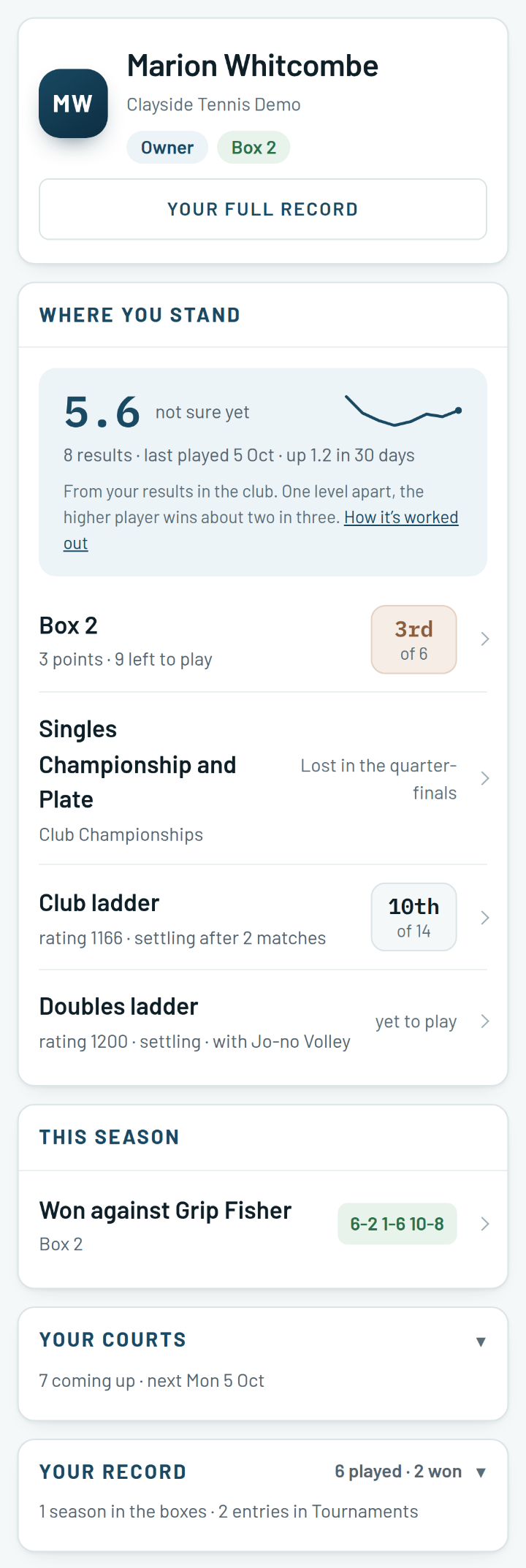
- Every member has a record: what they are in now and their last five results. It lists every box, ladder and tournament they have played, where they finished and whether they went up or down.
- Head to head on any name. Tap a player on a table, a draw or a game offer, and their record opens on you and them. It shows how many you have each won, and every match you have played against or with each other.
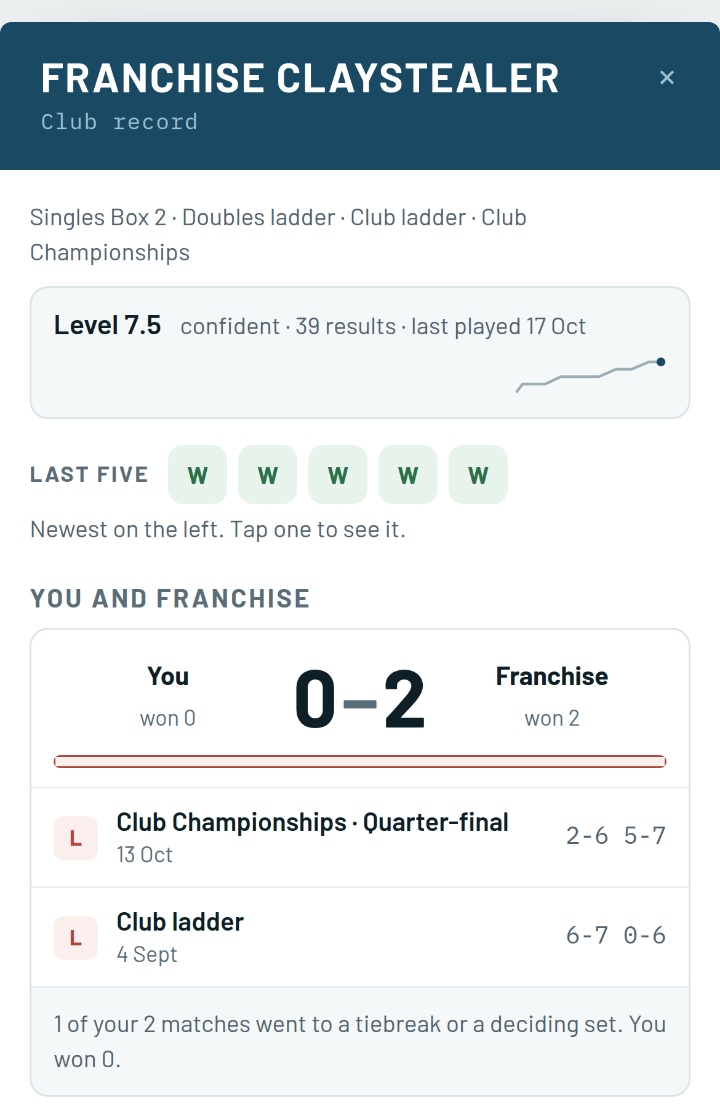
- Who they play most, each opening the head to head.
- The numbers players argue about: deciding sets and tiebreaks won, wins from a set down, their best run, and how many people they have played.
- The rules above, built in. A walkover is listed but not counted, a retirement counts for whoever took it, and only confirmed scores count.
- Milestones in Clubhouse, such as a first win, a winning run or a 25th match, shown to the club and with “well played” on each.
- The AGM figures, counted. The committee’s Stats screen shows how many members played, and how many came back, split by whether they played at all. Nobody is named, and each chart has a sentence ready to read out.
- Who is not playing. The register filters to the members playing now, and every record says when that member last played, so the ones drifting away stand out before renewal.
- Every result as a spreadsheet, one row per match, whenever the club wants its own copy.
The players enter the scores. The records, the head to heads and the milestones look after themselves.
Questions organisers ask
What stats should a tennis club track for each player?
Matches played and won, and the last five results. Then the head to head against each opponent, deciding sets and tiebreaks won, wins from a set down, the best run and where they finished.
Does a walkover count in a player's record?
List it, so the record is complete, but do not count it as a win or a loss. Nobody played, so it says nothing about either player.
Should doubles and singles records be kept separately?
Keep them in one list but show them apart. A doubles win belongs to a pair, and a player's singles record is what most people mean when they ask how somebody is doing.
Is a player's record personal data?
Yes. Results with names on them are personal data. Say in the club's privacy notice that results are recorded and shown to members. Let anybody who asks keep their results out of round-ups and highlights.
How do you work out a head to head in a spreadsheet?
With one row per match, filter on the two names. Count the rows each player won, and list the scores underneath. It is slow by hand, which is why most clubs never do it.
Filed under Competitions · Every sport